Different Braids
Table of Contents
:max_bytes(150000):strip_icc()/skaijackson-786b636962b2446a962d42012c9b15c5.jpg "Stylists Reveal How to Create 14 Different Types of Braids")
Box Braids
Square-shaped braids created by sectioning and dividing the hair into small equal parts and braiding each section underhand.
Can be long, medium, or short.
Versatile style that can be worn in various ways, including updos, buns, and side braids.
Different Braids
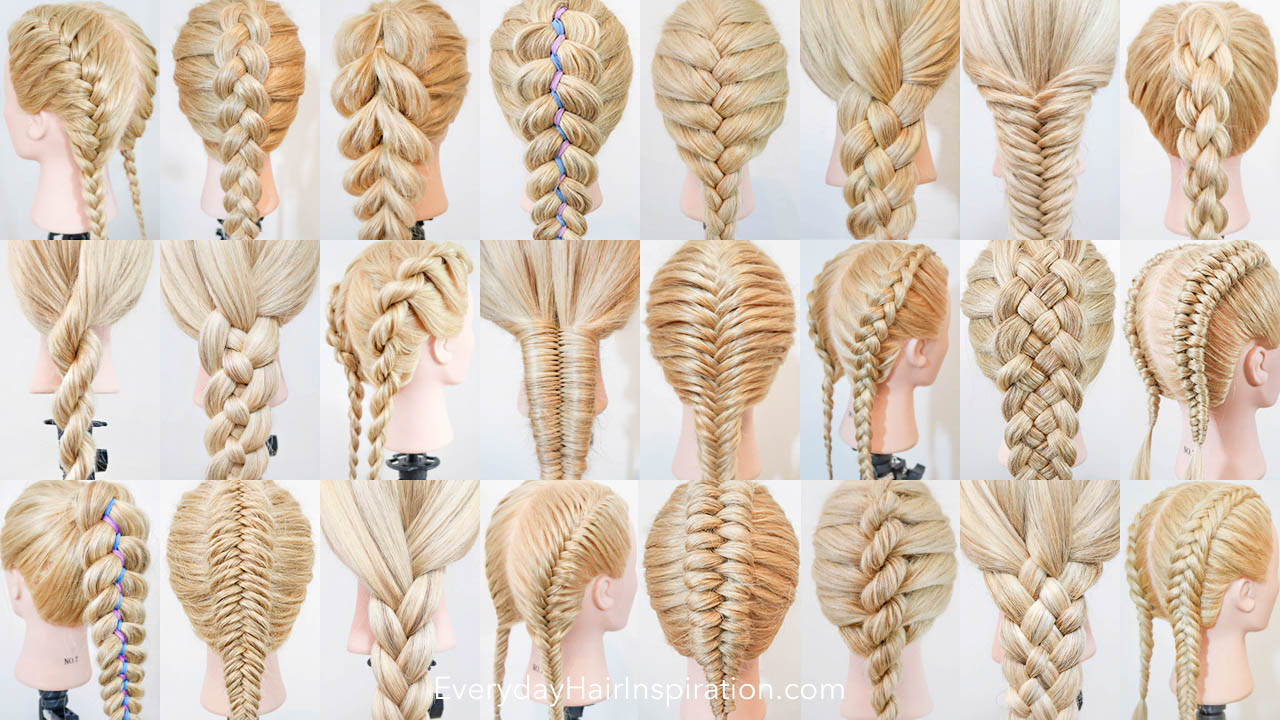
Braids in general can be classified into three main categories:
Underhand Braids: The hair is divided into three equal strands, with the right and left strands passing over the middle strand to form a new middle strand. This process is repeated to create a braid.
Overhand Braids: Similar to underhand braids, but the right and left strands pass under the middle strand to form the new middle strand.
Side Braids: A braid that is created by dividing the hair into two sections and then crossing one section over the other to create a new section. This process is repeated until the entire length of hair is braided.
Specific Braid Styles:
Cornrows: Tightly braided rows of hair with raised sections.
French Braids: Three-strand braids that begin at the top of the head and incorporate hair as it is braided down the length.
Dutch Braids: Similar to French braids, but the outer strands are crossed under the middle strand instead of over.
Fishtail Braids: Two-strand braids that create a fishtail pattern by crossing alternating strands from each side.
Crown Braids: Circular braids that go around the head.
Halo Braids: Similar to crown braids, but they are placed higher on the head, encasing the hair like a halo.
Chunky Braids: Large, bulky braids made from sections of thicker hair.
Palm Tree Braids: Box braids or cornrows that are gathered into a bun at the top of the head, resembling a palm tree.
Knotless Braids: Braids created without tying knots at the base, resulting in a seamless, less bulky appearance.
Square-shaped sections of hair braided from the root to the tip.

Box Braids: Square-shaped sections of hair braided from the root to the tip. They are typically medium to large in size and can be worn in various styles, such as buns, ponytails, and updos.
Cornrows: Similar to box braids, but much smaller in size. They are typically braided close to the scalp and can be worn in a variety of patterns, such as straight lines, curves, and zigzags.
French Braids: A three-strand braid that is started at the top of the head and gradually incorporates more hair as it is braided down the length of the hair. They can be worn in various styles, such as buns, ponytails, and crowns.
Dutch Braids: Similar to French braids, but the strands are crossed under instead of over each other, resulting in a raised braid.
Fishtail Braids: A two-strand braid that is created by taking thin sections of hair from the outer edges of the strands and crossing them over each other in a fishtail pattern.
Rope Braids: A simple braid that is created by twisting two strands of hair together and then wrapping them around each other.
Crown Braids: A braid that is worn around the head, resembling a crown. It can be made with various braiding techniques, such as French braids, Dutch braids, or three-strand braids.
Waterfall Braids: A braid that creates the illusion of a waterfall by leaving strands of hair loose while braiding the rest.
Braided Pigtails: Two braids that are worn on either side of the head, typically with the hair pulled back into a ponytail or bun.
Braided Halo: A braid that is worn around the back of the head, creating a halo effect. It can be made with various braiding techniques, such as French braids, Dutch braids, or three-strand braids.
Can be various sizes, lengths, and colors.
:max_bytes(150000):strip_icc()/braids-02197e1d911b44219b51b968f51a02dd.jpg "How To Braid Hair: 7 Types You Can Learn At Home")
1. French Braid: A classic braid that starts at the top of the head and gradually adds hair from the sides as it goes down.
2. Dutch Braid: Similar to a French braid, but the hair is added under the strands instead of over them, creating a raised effect.
3. Fishtail Braid: Two strands of hair are crossed over each other repeatedly, creating a pattern that resembles a fishtail.
4. Rope Braid: Two strands of hair are twisted together until they resemble a rope.
5. Milkmaid Braid: Two braids are created on either side of the head and then wrapped around the top, creating a bun-like effect.
6. Crown Braid: A braid that encircles the head, creating a crown-like appearance.
7. Waterfall Braid: A braid where sections of hair are released to create a cascading waterfall effect.
8. Boxer Braid: Two tight braids that run parallel to each other on either side of the head.
9. Half-Up Braid: A braid that starts at the crown of the head and ends halfway down, creating a half-up, half-down style.
10. Mermaid Braid: A variation of a fishtail braid where three or more strands of hair are used to create a more elaborate pattern.
11. Pancaking Braid: A braid where the strands are pulled apart to create a flat, pancake-like effect.
12. Macrame Braid: A braid that uses knots and cords to create intricate patterns.
13. Celtic Braid: A complex braid that often incorporates knots and Celtic symbols.
14. Infinity Braid: A continuous braid that appears to have no beginning or end.
15. Ladder Braid: A braid that resembles a ladder, with the strands crossing over and under each other to create a ladder-like pattern.
Versatile style that can be worn up or down, adorned with beads or accessories.

Updo Hairstyles
French Braid Crown: Braid a French braid from the front of the head to the back, wrapping it around the crown of the head and securing with bobby pins.
Dutch Braid Bun: Braid two Dutch braids on either side of the head, then gather them into a bun at the back of the neck.
Messy Top Knot: Create a high ponytail, then wrap it around the hairband to form a top knot. Leave loose strands around the face for a messy effect.
Braided Chignon: Divide hair into three sections and braid each one. Combine the braids into a low chignon and secure with bobby pins.
Down Hairstyles
Side-Swept Waterfall Braid: Braid a waterfall braid from the side of the head, allowing strands to fall over the shoulder.
Half-Up Dutch Braid: Create a Dutch braid from the crown of the head to the back, securing it at the nape of the neck. Leave the rest of the hair down.
Boxer Braids: Divide hair into two sections and braid two tight French braids, starting at the forehead and ending at the back of the neck.
Fishtail Braid: Divide hair into two sections and create a fishtail braid by crossing small strands from one side over the other.
Adornment Ideas
Beads: Add colorful or metallic beads to the ends of braids or scattered throughout the hair.
Ribbons: Tie ribbons into braids or wrap them around hairbands for a whimsical touch.
Flowers: Pin fresh or artificial flowers into braids or buns for a romantic or bohemian look.
Headbands: Wear beaded, metallic, or fabric headbands to adorn braids or keep hair out of the face.
Hairpins: Embellish braids with decorative hairpins featuring crystals, pearls, or feathers.
Cornrows
Cornrows
Cornrows are a type of braid that is created by tightly braiding the hair in rows that run parallel to each other. Cornrows can be worn in a variety of styles, including:
Single cornrows: These are the most basic type of cornrow, and they are created by braiding the hair in a single row that runs from the forehead to the nape of the neck.
Double cornrows: These are created by braiding the hair in two rows that run parallel to each other.
French cornrows: These are created by braiding the hair in a French braid that is then flattened against the head.
Ghana cornrows: These are created by braiding the hair in a series of small, tight cornrows that are then arranged in a geometric pattern.
Different Braids
In addition to cornrows, there are a number of other types of braids that can be used to create a variety of hairstyles. Some of the most popular types of braids include:
Box braids: These are created by braiding the hair into small, square-shaped sections.
Dreadlocks: These are created by allowing the hair to mat and tangle together.
Fishtail braids: These are created by braiding the hair into two sections that are then intertwined.
French braids: These are created by braiding the hair into three sections that are then crossed over each other.
Pigtail braids: These are created by braiding the hair into two sections that are then tied together at the ends.
Rope braids: These are created by twisting the hair into two sections that are then wrapped around each other.
Waterfall braids: These are created by braiding the hair into a series of small, loose braids that are then allowed to fall down the back of the head.
Raised, tight braids woven close to the scalp.

Cornrows
Parallel rows of tightly woven braids that run along the scalp
Can be styled in various patterns and designs
Traditional African hairstyle
French Braids
Three-strand braid where a new strand is added to the braid with each pass
Can be braided close to the scalp or loosely
Versatile style suitable for both formal and casual occasions
Dutch Braids
Similar to French braids but the strands are crossed under instead of over
Creates an elevated, voluminous look
Suitable for thick and long hair
Box Braids
Square-shaped braids that are created by partitioning the hair into small sections and braiding each section
Can be made with synthetic or natural hair
Long-lasting protective style
Fishtail Braids
Woven braid where the hair is divided into two strands and thin sections are interwoven
Creates a delicate, lace-like effect
Ideal for fine or medium hair
Waterfall Braids
Loose, cascading braid where a section of hair is released after each pass
Resembles a waterfall flowing down the hair
Romantic and elegant style
Rope Braids
Two-strand braid where the strands are twisted around each other
Thick and textured braid that adds volume
Can be braided with wet or dry hair
Halo Braids
Braid that wraps around the head like a headband
Creates a crown-like effect
Perfect for special occasions or festivals
Knotless Braids
Braiding technique that uses interlocking knots instead of braids
Reduces tension on the scalp and minimizes hair breakage
Ideal for sensitive scalps or fine hair
Bantu Knots
Small, raised buns that are created by wrapping hair around itself
Can be decorated with beads or accessories
Traditional African hairstyle, often used as a protective style
Run in straight lines or intricate patterns.

Straight-Line Braids
French Braid: A classic braid where each section of hair is brought over the middle, forming a tight, three-strand plait.
Dutch Braid: Similar to the French braid but with the sections pulled under the middle for a raised, chunky look.
Fishtail Braid: A mesmerizing braid created by crossing two sections of hair over each other at a time, forming a fishtail pattern.
Ladder Braid: A variation of the French braid where alternating sections of hair are left loose, forming a ladder-like design.
Waterfall Braid: A cascading braid where sections of hair are released and fall over the braid, resembling a waterfall.
Intricate Pattern Braids
Crown Braid: A braid that loops around the head like a crown, creating a regal and elegant look.
Milkmaid Braid: A pair of braids that start from the ears and cross over each other at the back of the head, giving the illusion of a milkmaid's headdress.
Mohawk Braid: A single braid that runs down the center of the head like a mohawk, adding a touch of edginess.
Celtic Braid: A complex braid with intricate knots and woven patterns, inspired by Celtic art.
Rope Braid: A thick, chunky braid formed by twisting two strands of hair together and then wrapping them around each other.
Pull-Through Braid: A unique braid where sections of hair are pulled through the braid rather than being brought over or under.
Braided Bun: A versatile and stylish updo where braids are incorporated into a bun, creating a variety of designs and textures.
Braided Ponytail: A ponytail with braids added for extra interest, such as Dutch braid or fishtail accents.
Pixie Braid: A delicate braid for short hair, often featuring small knots or twists throughout.
Can be worn as a protective style or as a decorative accent.

Protective Braids:
Box Braids: Rows of square-shaped braids created by sectioning the hair into small boxes.
Cornrows: Intricate braids that start at the front of the scalp and are woven towards the back.
Ghana Cornrows: Similar to traditional cornrows, but smaller and tighter, often adorned with beads or threads.
Jumbo Braids: Thick, chunky braids that can be any length.
Tribal Braids: Elaborate braids that incorporate beads, shells, or other adornments, inspired by different cultures.
Decorative Accents:
French Braids: Strands of hair are crossed over each other in a three-strand pattern, creating an elegant and feminine look.
Dutch Braids: Similar to French braids, but the strands are crossed under each other, resulting in a raised and intricate braid.
Fishtail Braids: Hair is divided into two equal sections and strands are taken from the outer edges of each section to create a woven effect.
Waterfall Braids: A portion of hair is braided and then released to flow down, creating the illusion of a waterfall.
Headband Braids: Braids that are wrapped around the headband to create a decorative and functional accent.
Fulani Braids
Fulani Braids
Fulani braids are a type of protective style often worn by women of Fulani descent in West Africa. They are characterized by long, thin cornrows that are intricately braided and adorned with beads, shells, or other embellishments. Fulani braids can be worn in a variety of styles, including:
Traditional Fulani Braids: These braids are typically worn by young girls and are characterized by their long, thin cornrows that are braided down the center of the head. They are often decorated with colorful beads or shells.
Modern Fulani Braids: Modern Fulani braids are a more contemporary take on the traditional style. They are typically worn by older women and are characterized by their shorter, thicker cornrows that are braided along the sides of the head. They are often decorated with more elaborate embellishments, such as gold or silver beads.
Box Braids: Box braids are a variation of Fulani braids that are created by sectioning the hair into small squares and braiding them together. They are typically worn by women of all ages and can be decorated with a variety of embellishments.
Different Braids
In addition to Fulani braids, there are many other types of braids that can be worn. Some of the most popular include:
Cornrows: Cornrows are a type of braid that is created by sectioning the hair into small, tight rows that are braided down the scalp. They can be worn in a variety of styles, including straight, curved, or zigzagged.
Box Braids: Box braids are a type of braid that is created by sectioning the hair into small squares and braiding them together. They are typically worn by women of all ages and can be decorated with a variety of embellishments.
Twists: Twists are a type of braid that is created by twisting two strands of hair together. They can be worn in a variety of styles, including loose, tight, or braided into buns or updos.
Dreadlocks: Dreadlocks are a type of braid that is created by allowing the hair to naturally mat and tangle. They can be worn in a variety of styles, including loose, tight, or braided into buns or updos.
The type of braid that you choose will depend on your personal style and preferences. With so many different options to choose from, you're sure to find a braid that you love.
Braids that originate at the center of the head and extend down to the sides.
Box Braids
Rectangular-shaped sections that are tightly braided down to the scalp
Can vary in size and length, and can be decorated with beads or other embellishments
Cornrows
Raised rows of hair braided tightly against the scalp
Typically formed with three or more strands, with the outer strands crossing over the center strand in an overhand knot
Can be styled in a variety of patterns, including geometric shapes or designs
Fulani Braids
Thick, beaded braids often adorned with cowrie shells, metal charms, or colorful beads
Originating from the Fulani people of West Africa, these braids are typically adorned in intricate patterns and designs
French Braids
A three-strand braid that is started at the crown of the head and gradually incorporates more hair as it is braided down
Can be worn as a single braid or multiple braids in various styles, such as buns, updos, or ponytails
Ghana Braids
Similar to cornrows, but they are thicker and usually have more hair added to them as they are braided down
Can be decorated with beads or other embellishments, and are often worn in a variety of styles
Goddess Braids
Intricate, voluminous braids that are often adorned with beads, shells, or other decorative elements
Can range in size and style, from loose and flowing to tight and elaborate
Jumbo Braids
Large, chunky braids that are often worn for a bold and statement-making look
Can be braided in various styles, such as a high ponytail, half-up half-down, or loose and flowing
Knotless Braids
Similar to box braids but are not attached to the scalp with knots
Create a more natural look and reduce tension on the hair and scalp
Can be styled in a variety of ways, including buns, updos, or ponytails
Micro Braids
Tiny, thin braids that are typically adorned with beads or other embellishments
Can be woven into intricate patterns and designs, creating a delicate and elaborate look
Rope Braids
A two-strand braid where the strands are twisted together and then wrapped around each other to create a rope-like effect
Can be worn as a single braid or multiple braids, and can be adorned with beads or other embellishments
Senegalese Twists
Two-strand twists that are coiled together to create a rope-like effect
Similar to rope braids, but are typically thicker and more voluminous
Can be decorated with beads or other embellishments, and are often worn in a variety of styles
Originated from the Fulani tribe in Africa.
Braids Originating from the Fulani Tribe in Africa
1. Fulani Braids:
Distinctive style featuring intricate, geometric patterns.
Formed by braiding hair into small, tight sections and then twisting them into knots or loops.
Typically adorned with beads, shells, or other embellishments.
2. Senegalese Twists:
Similar to Fulani braids but with thicker sections of hair twisted.
Can be styled with loose or tight twists and leave-out sections.
Often embellished with cowrie shells or metallic accents.
3. Ras Twists:
Inspired by Jamaican Rastafarian culture.
Created by twisting hair with or without extensions.
Can be styled in single or double-strand twists and adorned with dreadlocks.
4. Box Braids:
Also known as "cornrows" or "Ghana braids."
Involves sectioning hair into square or rectangular shapes and braiding it tightly.
Can be styled with various lengths, thicknesses, and patterns.
5. Tree Braids:
Inspired by the intricate branches of trees.
Created by braiding hair into multiple strands and weaving them together to form branches.
Often adorned with beads, feathers, or other natural elements.
6. Crochet Braids:
Involves using a crochet hook to attach synthetic hair extensions to natural hair.
Creates a versatile style that can be customized with different colors, textures, and lengths.
Can be styled in braids, buns, or other updos.
7. Ghana Weaves:
Traditional style from Ghana that involves weaving artificial hair into the natural hair.
Creates a full, voluminous look with a variety of braided styles.
Can be adorned with headbands, scarves, or jewelry.
Ghana Braids
Types of Ghana Braids
1. Zigzag Braids
Small, tightly braided cornrows that zigzag across the scalp, creating a geometric pattern.
2. Feed-in Braids
Similar to zigzag braids, but with extensions added to the braiding process to create a seamless, textured look.
3. Stitch Braids
Also known as invisible braids, these braids are created by interlacing extensions directly into the natural hair, resulting in a smooth, braidless appearance.
4. Jumbo Braids
Large, chunky braids that are typically styled in a loose, cascading manner. They can be accentuated with beads, cuffs, or other accessories.
5. Criss-Cross Braids
Braided cornrows that criss-cross over each other, creating a unique and intricate pattern.
6. Lemonade Braids
Small, beaded cornrows that are parted at the center and styled in a sleek, ponytail-like manner.
7. Knotless Braids
Braids created without the use of any knots at the root, resulting in a natural-looking and protective style that is less prone to breakage.
8. Tribal Braids
Elaborate and intricate braids that draw inspiration from traditional African hairstyles. They may include beads, shells, or other decorative elements.
9. Box Braids
Square-shaped braids that are created by sectioning the hair into equal squares and braiding them down from the root.
10. Dreadlocks Braids
Braids created by locking sections of hair together using a crochet needle or rubber band. They can be styled in various ways, including dreadlocks, locs, or twists.
Tight, small braids that are not raised.
Similar to cornrows but follow a more curved pattern.
Zigzag Braids:
Create a zig-zag parting along the scalp, resembling a lightning bolt.
Separate and braid small sections of hair along the parting, alternating between under and over techniques.
Herringbone Braids:
Divide hair into two equal sections.
Take a small section from the left and cross it over to the right, then take a small section from the right and cross it over to the left.
Continue crossing sections from left to right and right to left, creating a fishbone-like pattern.
Tornado Braids:
Create a ponytail at the desired height on the head.
Divide the ponytail into two sections.
Twist one section clockwise and the other counterclockwise.
Wrap the twisted sections around each other, creating a tornado-like effect.
Rope Braids:
Divide hair into two equal sections.
Twist one section to the right and the other to the left.
Wrap the twisted sections around each other, creating a rope-like braid.
Fishtail Braids:
Divide hair into two equal sections.
Take a small section from the outside of the left section and cross it over to the inside of the right section.
Repeat this process with a small section from the outside of the right section and cross it over to the inside of the left section.
Continue alternating until you reach the end of the hair.
Celtic Knot Braids:
Divide hair into four equal sections.
Cross the first and second sections over the third and fourth sections.
Cross the third and fourth sections over the first and second sections.
Repeat this pattern, creating a knot-like design.
Crown Braids:
Create a circular parting around the crown of the head.
Braid small sections of hair along the parting, pulling them towards the center to create a crown-like effect.
Can be worn short or long, and can sometimes be combined with other braid styles.
Box Braids
Square-shaped braids created by sectioning hair into small squares and braiding them tightly to the roots.
Can be worn short or long, with various thicknesses.
Can be accessorized with hair extensions or beads.
Cornrows
Raised, close-to-the-scalp braids that are created by braiding the hair in straight or curved lines.
Can be worn in a variety of patterns, such as straight, zigzag, or fishbone.
Often used as a protective style for natural hair.
French Braids
Multi-strand braids where a small section of hair is taken from the top of the head, divided into three strands, and braided over and under the remaining hair.
Can be worn in various sizes and patterns, such as ponytails or buns.
Can be combined with other braid styles to create more intricate looks.
Fishbone Braids
Similar to French braids, but use a technique that creates a zigzag or "fishbone" pattern.
Can be worn in different thicknesses and lengths.
Often used as a decorative element in hairstyles.
Dreadlocks
Permanent or semi-permanent braids formed by neglecting to comb or brush the hair, allowing it to tangle and knot naturally.
Can vary in size and shape, and can be decorated with beads or accessories.
Often associated with Rastafarian culture.
Ghana Braids
Small, box-shaped braids that are tightly braided close to the scalp.
Originated in Ghana and are often considered to be a protective style.
Can be worn in a variety of patterns and lengths.
Twists
Two-strand braids created by twisting two sections of hair together.
Can be worn in different sizes and lengths, and can be combined with other braid styles.
Often used as a protective style for natural hair.
Havana Twists
A type of twist braid that uses extensions to create thick, rope-like braids.
Gives the illusion of longer, fuller hair.
Can be worn in various patterns and styles.
Fulani Braids
A traditional African hairstyle that features cornrows adorned with ornate beads or cowrie shells.
Often worn in Senegal and Mali.
Can be worn in different sizes and shapes, depending on the region.
Knotless Braids
Knotless Braided Styles
Box Braids: Straight, square-shaped braids created by separating hair into equal sections and braiding with synthetic extensions.
Cornrows: Raised, tight braids that are woven in rows, often used for protective styling or intricate designs.
Fulani Braids: Intricate, beaded braids originating from the Fulani people. They feature long, thin braids adorned with colorful beads and charms.
Ghana Braids: Flattened, woven braids that are typically worn close to the scalp. They can be straight or curved.
Jumbo Braids: Large, voluminous braids that are quick and easy to install. They can be left loose or styled into an updo.
Lemonade Braids: Long, flowing braids that are styled in a high ponytail or a headband. They were popularized by Beyoncu00e9.
Butterfly Braids: Inverted French braids that create a butterfly-like effect. They can be styled in an updo or left loose.
Tree Braids: Similar to box braids, but with the ends left loose and fluffy, resembling a tree.
Stitch Braids: A combination of box braids and cornrows, where cornrows are braided along the sides of the head and the rest of the hair is box braided.
Knotless Goddess Braids: Loose, individual braids that are tied without a knot, creating a voluminous and flowy look.
Other Braided Styles
French Braids: A three-strand braid that is woven by crossing the outer strands over the middle strand.
Dutch Braids: Similar to French braids, but the outer strands are crossed under the middle strand, creating a raised effect.
Fishtail Braids: A two-strand braid that resembles a fishtail. It is woven by crossing small sections of hair from one side to the other.
Braided Buns: Any type of braid that is wrapped into a bun. They can be messy, elegant, or a combination of both.
Braided Headbands: A single braid that is worn around the head like a headband. It can be decorated with beads or hair accessories.
Braided Crowns: A series of braids that are interlocked or sewn together to create a crown-like effect on the head.
African Threading: A protective style where the hair is wrapped with thread to create intricate designs.
Twisted Braids: Two strands of hair that are twisted together to create a braided effect. They can be flat or voluminous.
Braided without knots or tension at the root.
Knotless Braids
Box Braids: Straight, square-shaped braids with no knots at the root.
Fulani Braids: Box braids embellished with beads, cowrie shells, or hair accessories.
Passion Twists: Two-strand twists that resemble locs, with a fluffy and voluminous texture.
Goddess Braids: Loose, free-flowing braids that blend different braid techniques, such as box braids, cornrows, and twists.
Tension-Free Braids
Cornrows: Raised, plaited rows of hair that run from the front to the back of the head.
French Braids: Three-strand braids that are added to the scalp as they are created, with a smooth and elegant finish.
Dutch Braids: Similar to French braids, but with the under strands crossed over the top strands, resulting in a raised or textured effect.
Fishtail Braids: Braids created by dividing the hair into two equal sections and crossing one section over the other, creating a fishtail-like pattern.
Other Braids
Dreadlocks: Strands of hair that are matted and twisted together, creating a permanent and unique look.
Microlinks: Extensions that are attached to natural hair using tiny metal rings, allowing for versatility and a natural blend.
Faux Locs: Synthetic or natural hair extensions that resemble locs, but are easier to install and remove.
Crochet Braids: Extensions that are crocheted into natural hair to create a variety of styles, including braids, locs, and updos.
Creates a more natural, seamless look.
Loose Braids
Beach Waves Braid: Creates loose, beachy waves by braiding slightly damp hair and letting it air dry.
Boho Braid: A loose, flowing braid with a messy, bohemian vibe.
Buttermilk Braid: A gentle, side-swept braid that gives the hair a soft, romantic look.
Fishtail Braid: A decorative braid with an intricate, interlocking pattern.
Intricate Braids
French Braid: A classic braid that starts at the crown and feeds in hair as it goes down.
Dutch Braid: Similar to a French braid, but the hair is crossed under instead of over, creating a more voluminous braid.
Half Crown Braid: A braid that begins at one side of the head, wraps around the crown, and ends at the opposite side.
Milkmaid Braid: Two French braids that meet at the top of the head and are intertwined to create a crown-like effect.
Celtic Knot Braid: A complex braid with intricate interweaving and knotting that creates a unique, ornamental look.
Updo Braids
Braided Bun: A braid that is wrapped around a bun to create a polished and elegant updo.
French Twist Braid: A French braid that is coiled into a bun for a sophisticated and timeless look.
Braided Top Knot: A sleek and chic updo created by securing a high ponytail with a braid.
Braided Mohawk: A bold and edgy hairstyle where the sides of the head are shaved or shaved and a prominent braid runs down the center.
Crown Braid Updo: A braid that is wrapped around the head to create a crown-like effect, with the remaining hair pinned or left down.
Creative Braids
Halo Braid: A braid that circles the head like a halo, creating a whimsical and bohemian look.
Twisted Braids: Braids that are created by twisting small sections of hair together and intertwining them.
Box Braids: Small, square-shaped braids that are installed close to the scalp for a protective and stylish hairstyle.
Dreadlock Braids: Intentional or natural mats of hair that are formed by interlocking and twisting unruly strands.
Braided Bangs: Bangs that are styled into a braid to add texture and interest to the face frame.
Can be worn in a variety of styles, including box braids, cornrows, and Fulani braids.
Braiding Styles
Braids are a versatile and popular way to style hair. They can be worn in a variety of styles, including:
Box braids: These are square-shaped braids that are typically made with extensions. They can be worn in a variety of lengths and thicknesses, and can be styled in a variety of ways.
Cornrows: These are tight, raised braids that are created by cornrowing the hair. They can be worn in a variety of patterns, and can be decorated with beads or other accessories.
Fulani braids: These are a type of cornrow that is popular among the Fulani people of West Africa. They are typically braided in a curved pattern, and can be decorated with beads or other accessories.
Knotless braids: These are a type of braid that is created without using any knots. They are made by wrapping the hair around itself, and can be worn in a variety of styles.
Tree braids: These are a type of braid that is created by braiding the hair around a small piece of fabric or leather. They can be worn in a variety of lengths and thicknesses, and can be styled in a variety of ways.
Dreadlocks: These are a type of braid that is created by letting the hair loc naturally. They can be worn in a variety of lengths and thicknesses, and can be styled in a variety of ways.
Braids are a great way to protect hair from damage, and they can also be used to create a variety of different looks. They are a popular choice for both men and women, and they can be worn in a variety of settings.
Micro Braids
Extremely small, individual braids that are tightly woven.
Micro Braids
Box Braids: Small square-shaped braids that are tightly woven down the scalp.
Cornrows: Three-strand braids that are cornrowed close to the scalp.
Fulani Braids: Cornrows that extend from the front of the head to the nape of the neck, with smaller braids or beads woven in between.
Ghana Braids: Similar to box braids, but smaller and thinner, creating a more intricate look.
Invisible Braids: Tiny braids that are hidden underneath larger braids or hair extensions, giving the illusion of fullness.
Lemonade Braids: Box braids that are styled into a high ponytail, resembling the hairstyle worn by Beyoncu00e9 in her "Lemonade" music video.
Passion Twists: Afro-kinky braid extensions that are curled into twists, creating a soft and voluminous look.
Tree Braids: Tiny braids that are woven in a tree-like shape, starting at the nape of the neck and spreading out towards the crown.
Waterfall Braids: Braids that are braided along the back of the head and then cascade down around the face like a waterfall.
Zigzag Braids: Cornrows that are braided in a zigzag pattern, creating a unique and edgy look.
Can take a long time to install but last for several months.
Long-Lasting Braided Hairstyles:
1. Box Braids:
- Time to Install: 8-12 hours
- Longevity: 2-3 months
- Tightly plaited columns of hair that create a box-like effect.
2. Cornrows:
- Time to Install: 3-6 hours
- Longevity: 2-3 months
- Raised rows of hair braided in a straight line from the front to the back.
3. Senegalese Twists:
- Time to Install: 6-8 hours
- Longevity: 2-3 months
- Two strands of hair twisted together to create rope-like extensions.
4. Dreadlocks:
- Time to Install: 1 hour (initial installation) + ongoing maintenance
- Longevity: Indefinite
- Sections of hair that are left to tangle and mat together.
5. Havana Twists:
- Time to Install: 6-9 hours
- Longevity: 2-3 months
- A variation of Senegalese twists with added Marley hair extensions for volume.
6. Faux Locs:
- Time to Install: 6-8 hours
- Longevity: 2-3 months
- Synthetic hair strands looped and wrapped around sections of natural hair to mimic dreadlocks.
7. Invisible Braids:
- Time to Install: 4-6 hours
- Longevity: 2-3 months
- Braided underneath layers of hair, making them less visible but still providing length and volume.
8. Tribal Braids:
- Time to Install: 6-10 hours
- Longevity: 2-3 months
- Intricate patterns and designs woven into the hair with various braiding techniques.
Create a sleek, polished look.
Sleek and Polished Braided Hairstyles
1. French Twist Braid:
Style hair into a low ponytail.
Separate the ponytail into three sections.
Braid the right and left sections under the middle section, crossing them over it.
Repeat on the other side, crossing the sections over the middle.
Continue braiding, bringing the hair up towards the nape.
Pin the braid in a bun shape, concealing the ends.
2. Dutch Braid Crown:
Start with a deep side part.
Take a three-strand section from the hair closest to the part.
Cross the right strand under the middle, then the left strand under the middle.
Add small sections from the sides as you braid, keeping the braid tight.
Bring the braid across the head, forming a crown.
Secure the end of the braid behind the starting point.
3. Sleek Ponytail with Braided Detail:
Brush hair into a high ponytail.
Take a small section from the front of the ponytail and braid it.
Wrap the braid around the ponytail base, securing it with bobby pins.
Use a finishing spray to smooth flyaways and create a polished look.
4. Braided Chignon:
Gather hair into a low ponytail.
Divide the ponytail into two sections.
Braid each section and wrap them around each other.
Pin the ends of the braids together to form a bun.
Smooth out any loose ends and use hairspray to hold the style in place.
5. Twisted Crown Braid:
Create a deep center part.
Twist two sections of hair on either side of the part.
Cross the right twist over the left and pin it.
Cross the left twist over the right and pin it.
Continue twisting and crossing the sections until you reach the nape.
Secure the ends of the braid with bobby pins.
6. Slicked-Back Braided Bun:
Apply a generous amount of gel or pomade to damp hair.
Comb hair straight back and secure it in a high ponytail.
Divide the ponytail into three sections and braid them.
Wrap the braid around the ponytail base and pin it in place.
Smooth out any remaining flyaways and add hairspray for hold.
Passion Twists
Two-strand twists that are created by wrapping two sections of hair around each other.
Two-strand twists: These are the most basic type of braid and are created by wrapping two sections of hair around each other. They can be done on any type of hair and are a great way to add texture and volume.
Three-strand braids: These are the most common type of braid and are created by dividing the hair into three sections and then braiding them together. They can be done in a variety of styles, such as a French braid, a Dutch braid, or a fishtail braid.
Four-strand braids: These are similar to three-strand braids, but they are created using four sections of hair instead of three. They can be done in a variety of styles, such as a square braid, a Celtic braid, or a rope braid.
Five-strand braids: These are more complex than three-strand or four-strand braids and are created using five sections of hair. They can be done in a variety of styles, such as a round braid, a star braid, or a heart braid.
Six-strand braids: These are the most complex type of braid and are created using six sections of hair. They can be done in a variety of styles, such as a spiral braid, a helix braid, or a ladder braid.
Can be chunky or fine, and can be worn short, long, or in buns.
Resemble dreadlocks but are removable.
Faux Locs: Synthetic locs that are crocheted into the hair. They resemble dreadlocks but can be removed and replaced easily.
Crochet Braids: Similar to faux locs, but made with human or synthetic hair extensions. They are crocheted into the hair, creating small, individual braids.
Box Braids: Rectangular-shaped braids made by dividing the hair into small squares and braiding them tightly against the scalp.
Cornrows: Raised, straight-line braids that are typically done from the front of the head to the back or sides.
French Braids: Circular braids where one strand is passed over the other two strands repeatedly. They can be done high on the head, or low at the nape.
Dutch Braids: Similar to French braids, but the strands are passed under the other two strands instead of over. This creates a more raised, elevated braid.
Fishtail Braids: A style that resembles a fishtail, with small sections of hair woven together in an interlocking pattern.
Rope Braids: Two sections of hair are twisted together, then interlaced to create a rope-like effect.
Halo Braids: A circular braid that frames the head like a halo. It can be done with a single braid or multiple braids.
Waterfall Braids: A braid that starts at the crown of the head and falls down one side, resembling a waterfall. It is often combined with other braids.
Crown Braids: A braid that encircles the head, creating a crown-like effect. It can be done with a single braid or multiple braids.
Senegalese Twists
Senegalese Twists
Senegalese twists are a type of protective style that involves twisting two strands of hair together. The twists are typically thin and can be worn long or short. Senegalese twists are a versatile style that can be dressed up or down and are suitable for all hair types.
Different Types of Senegalese Twists
There are several different types of Senegalese twists, including:
Standard Senegalese Twists: These are the most common type of Senegalese twist and involve twisting two strands of hair together.
Jumbo Senegalese Twists: These twists are larger than standard Senegalese twists and involve twisting three or more strands of hair together.
Micro Senegalese Twists: These twists are smaller than standard Senegalese twists and involve twisting two strands of hair together with the help of a crochet hook.
Butterfly Senegalese Twists: These twists are created by twisting two strands of hair together and then dividing the twist in half.
Benefits of Senegalese Twists
Senegalese twists offer a number of benefits, including:
Protective: Senegalese twists help to protect the hair from damage caused by heat styling, brushing, and combing.
Versatile: Senegalese twists can be worn in a variety of styles, including buns, ponytails, braids, and twists.
Low-maintenance: Senegalese twists are relatively low-maintenance and can last for several weeks.
Suitable for all hair types: Senegalese twists are suitable for all hair types, including natural, relaxed, and colored hair.
How to Get Senegalese Twists
Senegalese twists can be done at home or at a salon. If you are doing them at home, you will need the following supplies:
Hairbrush
Comb
Hair clips
Twisting cream
Hair wax
Edge control
To get Senegalese twists, follow these steps:
1. Wash and condition your hair.
2. Brush and comb your hair to remove any tangles.
3. Divide your hair into small sections and clip each section away from the rest of your hair.
4. Apply twisting cream to one section of hair.
5. Divide the section of hair into two strands.
6. Twist the two strands of hair together.
7. Continue twisting the hair until you reach the end of the section.
8. Secure the twist with a hair clip.
9. Repeat steps 4-8 for each section of hair.
10. Once all of the sections are twisted, apply hair wax to the twists.
11. Apply edge control to the edges of your hair to smooth them down.
Maintenance
Senegalese twists can last for several weeks, but they will need to be maintained to keep them looking their best. To maintain Senegalese twists, follow these tips:
Wash your hair every 1-2 weeks with a gentle shampoo.
Condition your hair every 2-3 weeks.
Moisturize your twists with a twisting cream or hair oil every day.
Avoid using heat styling tools on your twists.
Tie your twists up at night to prevent them from tangling.
Similar to passion twists but with multiple strands used instead of two.
Creates a thicker, more voluminous look.
Cornrows
Technique: Small, tight braids that are created by braiding the hair close to the scalp in straight lines.
Effect: A raised, textured look that can create the illusion of volume and thickness.
Variations: Box braids, Ghana braids, Zulu braids.
Box Braids
Technique: Similar to cornrows, but with larger, square-shaped braids.
Effect: A bold, geometric look that adds significant volume and thickness.
Variations: Jumbo box braids, micro box braids.
Crochet Braids
Technique: Hair extensions are attached to the natural hair using a crochet hook, creating individual locs or braids.
Effect: A versatile style that can achieve different looks, including voluminous curls, dreadlocks, or box braids.
Variations: Senegalese twists, box crochet, passion twists.
Tree Braids
Technique: Braids that are created by sectioning the hair into cornrows and then braiding the sections together at intervals.
Effect: A unique and intricate style that results in a cascading or "tree-like" appearance.
Variations: Single tree braids, double tree braids.
Butterfly Braids
Technique: Two braids are created and placed side by side, then the two inside sections are braided together and pulled through the middle.
Effect: A delicate and girly look that adds subtle volume and movement.
Variations: Half-up butterfly braids, braided buns.
Fulani Braids
Technique: Braids that are created along the hairline and decorated with beads or charms.
Effect: An elegant and tradit
Post a Comment for "Different Braids"